
[PROJECT] Creating an efficient gRPC Client-Server Communication

![[PROJECT] Creating an efficient gRPC Client-Server Communication](/assets/images/PRJ-gRPC/cover_gRPC.png)
gRPC (gRPC Remote Procedure Calls) is a high-performance, open-source framework developed by Google that enables efficient communication between distributed systems.
The project aims to demonstrate how to set up a gRPC client-server communication using JavaScript and demonstrate the key features and benefits of gRPC such as sending single messages and streaming data between client and server.
Remote Procedure Calls (RPC)
At its core, gRPC is built around the concept of Remote Procedure Calls (RPCs). RPCs allow a program to execute a procedure (or method) on a remote server as if it were a local function call. This abstraction simplifies the development of distributed applications by hiding the complexities of network communication.
💡 Read more about gRPC on the official gRPC website.
The Core Concepts of gRPC
gRPC operates on the concept of defining services and their methods using Protocol Buffers. Protocol Buffers is a binary serialization format that is both compact and efficient to compute, making it ideal for high-performance communication.
The process involves the following steps:
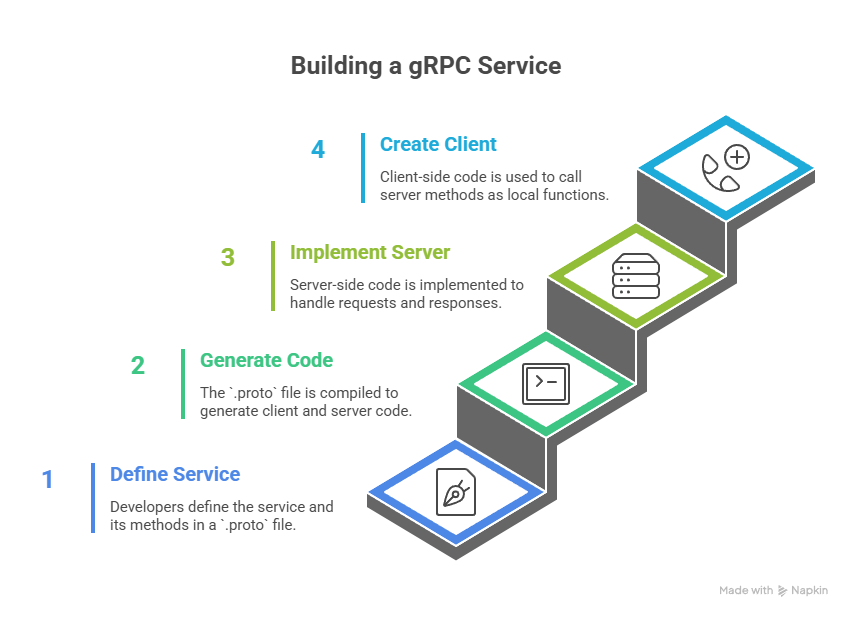
- Define the Service: Developers define the service and its methods in a .proto file using Protocol Buffers syntax. Each method specifies the request and response message types.
- Generate Code: The .proto file is then compiled using the Protocol Buffers compiler (protoc), which generates client and server code in the desired programming languages.
- Implement the Server: The server-side code is implemented to handle incoming requests and provide the appropriate responses.
- Create the Client: The client-side code is used to call the server methods as if they were local functions, abstracting away the complexities of network communication.
Key Features of gRPC
- High Performance: gRPC leverages HTTP/2, which provides features like multiplexing, header compression, and server push, resulting in lower latency and improved performance compared to traditional RESTful APIs.
- Language Agnostic: gRPC supports multiple programming languages, including Python, Java, C++, Go, Ruby, and more, making it suitable for polyglot environments.
- Streaming Support: gRPC supports four types of service methods: unary (single request-response), server streaming (single request, multiple responses), client streaming (multiple requests, single response), and bidirectional streaming (multiple requests and responses).
- Built-in Authentication: gRPC provides built-in support for authentication and encryption using SSL/TLS, ensuring secure communication between clients and servers.
- Pluggable Architecture: gRPC allows developers to extend its functionality through custom plugins, such as interceptors for logging, monitoring, and error handling.
Use Case: gRPC Client-Server Communication
Commonly, gRPC is used in microservices architectures, where different services need to communicate with each other efficiently. It is also used in scenarios where low latency and high throughput are critical, such as real-time applications, IoT systems, and mobile applications.
Famous companies like Google, Netflix, and Dropbox use gRPC for their internal services due to its performance and scalability.
Project Example: Implementing a gRPC Client-Server in JavaScript
To demonstrate gRPC client-server communication in JavaScript, we will set up a simple example where a client sends a request to the server, and the server responds with a message.
Step 1: Define the Service
Create a file named service.proto to define the gRPC service and its methods.
  syntax = "proto3";
  package grpc_example;

  service Greeter {
    // Sends a greeting
    rpc SayHello (HelloRequest) returns (HelloReply) {}
  }

  // The request message containing the user's name.
  message HelloRequest {
    string name = 1;
  }

  // The response message containing the greetings
  message HelloReply {
    string message = 1;
  }

  // define the structure for the data you want to serialize
  message Person {
      string name = 1;
      int32 age = 2;
      bool is_student = 3;
  }

  message DataResponse {
      // The response message containing the result
      string result = 1;
  }
Step 2: Generate Code
Use the Protocol Buffers compiler to generate JavaScript code from the service.proto file.
protoc --js_out=import_style=commonjs,binary:. --grpc-web_out=import_style=commonjs,mode=grpcwebtext:. service.proto
Step 3: Implement the Server
Create a file named server.js to implement the server-side logic.
  from concurrent import futures
  import grpc
  import service_pb2
  import service_pb2_grpc

  class ExampleServiceServicer(service_pb2_grpc.ExampleServiceServicer):
      def GetData(self, request, context):
          # Implement the logic to process the request and generate a response
          response = service_pb2.DataResponse()
          response.result = f"Received query: {request.query}"
          return response

  def serve():
      server = grpc.server(futures.ThreadPoolExecutor(max_workers=10))
      service_pb2_grpc.add_ExampleServiceServicer_to_server(ExampleServiceServicer(), server)
      server.add_insecure_port('[::]:50051')
      server.start()
      print("Server started on port 50051")
      server.wait_for_termination()

  if __name__ == '__main__':
      serve()
Step 4: Create the Client
Create a file named client.js to implement the client-side logic.
  const grpc = require('@grpc/grpc-js');
  const protoLoader = require('@grpc/proto-loader');
  const packageDefinition = protoLoader.loadSync('service.proto', {
      keepCase: true,
      longs: String,
      enums: String,
      defaults: true,
      oneofs: true
  });
  const grpcExample = grpc.loadPackageDefinition(packageDefinition).grpc_example;

  function main() {
      const client = new grpcExample.Greeter('localhost:50051', grpc.credentials.createInsecure());

      const request = { name: 'World' };

      client.SayHello(request, (error, response) => {
          if (error) {
              console.error('Error:', error);
          } else {
              console.log('Greeting:', response.message);
          }
      });
  }

  main();
Step 5: Run the Server and Client
- Start the server by running python server.py in one terminal.
- In another terminal, run the client by executing python client.py. You should see the server output indicating it has started, and the client will print the response received from the server.
Conclusion
gRPC is a powerful framework for building efficient and scalable distributed systems. Its use of HTTP/2 and Protocol Buffers makes it a high-performance alternative to traditional RESTful APIs. By following the steps outlined in this example, you can quickly set up a gRPC client-server communication in Python, enabling you to build robust microservices and distributed applications.
Explore more like this
Essential API Types Every Developer Should Know
APIs (Application Programming Interfaces) are the connective tissue of modern software. They allow systems, apps, and services to talk to each other, powering everything from social media integrations to banking...
Comments